Risk and regulatory notice: Binary options are high-risk, all-or-nothing products and may be prohibited or restricted for retail customers where you live. You can lose the full amount committed to a trade. Verify the legal entity and its authorisation in an official regulator register before sending money or identity documents. This page is general information, not personal financial advice.
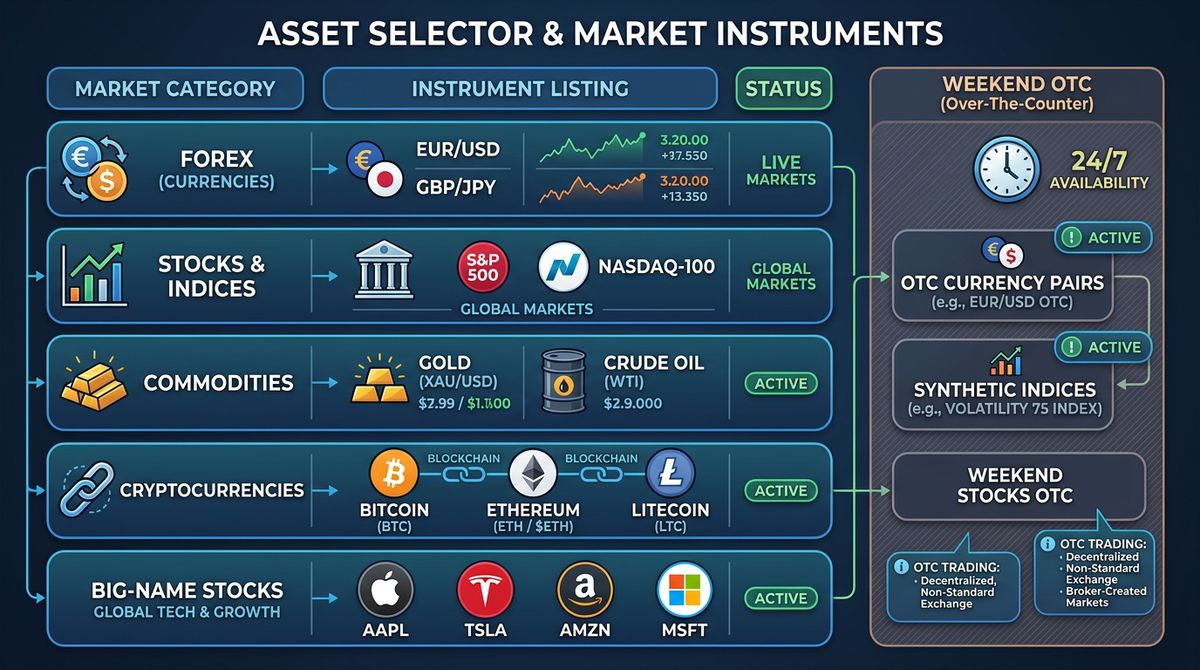
Quotex assets are the underlying markets, like currency pairs, indices, commodities, cryptocurrencies, and a handful of stocks, that I can speculate on through short-expiry up/down contracts. Listed counts vary by source: one review counted around 68 binaries and OTC options, another over 95 binary instruments, while Quotex markets over 400 instruments overall, but the practical reality is narrower than the marketing suggests. Here’s what actually trades, what doesn’t, and how to think about asset choice on this platform.
Assets Explained
What Quotex Actually Is (and What "Assets" Means Here)
Quotex is a digital options platform, sometimes called binary options, where I predict whether a market will close above or below its current price by a set expiry. I’m not buying the underlying instrument. There is no spot ownership, no leveraged CFD position, and no exchange-listed option contract. The “asset” is the underlying price my contract references, as the Service Agreement §§1.1–1.3[2] describes.
One third-party test lists expiries from 5 seconds to 4 hours and sub-second execution in its test [1]; those are not guaranteed conditions in every account. That combination shapes how asset choice works: I’m not picking something to hold, I’m picking a price feed that needs to behave predictably over a very short window.
Asset Lineup
The Full Asset Lineup on Quotex
Asset totals depend heavily on who’s counting. A third-party review [1] reports over 95 binary instruments and 400+ overall; the operator also markets 400+ total instruments[3]. A separate review counts around 68 binary/OTC options across five classes. Those counts come from different reviewers and methods; they do not establish the number available in my account today.
Forex, Indices, and Commodities
Forex is the deepest category. A third-party review lists 43+ currency pairs, including EUR/USD, GBP/JPY, AUD/USD, CAD/CHF, and some exotic pairs like USD/IDR. Major pairs have the tightest spreads and most consistent payout behavior during London and New York sessions.
Indices coverage runs around 10 to 15 instruments. The FTSE 100, Dow Jones, NASDAQ, DAX, Nikkei 225, Hang Seng, and CAC 40 show up most often. Notably, one review reports the S&P 500 absent, while the separate test [1] included it. The current asset selector is what settles availability in my account.
Commodities are limited to the headliners: Gold (XAU/USD), Silver, WTI Crude, and Brent. That is not a complete or permanent list; the current selector can differ.
Cryptocurrencies and Stocks
Crypto depth is shallow. Depending on the source and region, I’ll see Bitcoin, Ethereum, Litecoin, and Ripple, or a smaller set like Bitcoin, Dogecoin, and Pepe. Check the live selector for Solana, Cardano or other coins; the available list can change.
Stocks are the thinnest category. One review lists 8+ stocks, including Microsoft, Pfizer and Boeing, while another [1] lists Tesla and Apple; specific tickers vary by observation. This isn’t a place to trade equity ideas; it’s a place to take directional bets on a handful of household names.
OTC Assets and 24/7 Trading
OTC mode extends trading across the same four core categories on weekends and outside exchange hours. The Service Agreement §1.2[2] says Quotex determines the displayed asset rate using several external inputs; it does not establish a specific OTC feed methodology. I treat OTC payouts and price action as potentially different from exchange-hours versions. OTC is useful for practice and weekend activity, but I treat it as a separate product, not the same EUR/USD I’d trade on a Tuesday afternoon.
What You Can't Trade on Quotex
Setting expectations matters here. Quotex does not offer:
- Spot ownership of any asset
- Ladder, boundary, or one-touch contracts
- Guaranteed early closure or rollover on open positions; the Trading Rules §§5.6–5.9[4] allow early closure only if technically available and accepted
- MT4, MT5, or cTrader integration; Quotex offers web, Android and an iOS PWA[5]
- Bonds, ETFs, or futures in any meaningful form
- Leveraged CFD positions
The product is a simple up/down digital option. That’s the entire toolkit. If I want hedging structures, longer-dated exposure, or actual share ownership, this isn’t the platform. Many traders comparing brokers find this limitation makes how Quotex stacks up against competitors a closer call than the asset count suggests.
Availability & Quality
Asset Availability vs. Trade Quality
This is the section that matters most. A 400+ total-instrument marketing claim doesn’t mean 400 binary assets available to me at any given moment. Payout rates fluctuate by asset and session, sometimes dramatically.
| Asset | Advertised Payout | Peak Session | Off-Peak |
|---|---|---|---|
| EUR/USD (5 min) | 98% | 94–96% | 80–85% |
| BTC (30 min) | 96% | 92–94% | 82–86% |
| S&P 500 | 88% | 84–87% | 76–80% |
| XAU/USD (Gold) | 90% | 86–88% | 78–82% |
In the third-party sample [1], peak payouts were 2–4 percentage points below the advertised figures and off-peak results 8–18 points below for the tested assets. On a binary contract where a single percentage point shifts long-run expected value, that’s not a rounding error. It’s the difference between a tradable edge and a guaranteed grind down.
My take after watching this play out: asset counts are marketing numbers. Of the hundreds advertised, only 20 to 30 have consistent liquidity, stable payouts, and reasonable price behavior during my trading hours. That’s the real tradable universe.
Choosing Assets
How to Choose Which Quotex Assets to Trade
I stick to liquid majors during overlap hours. EUR/USD, GBP/USD, USD/JPY, Gold, and Bitcoin during the London-New York overlap (roughly 8 AM to noon Eastern) consistently show better payouts and cleaner price action than exotic pairs at 3 AM. Before placing a trade, I check the live payout on the asset because the number can shift minute to minute, especially on crypto and minor pairs.
The demo environment is the right place to test how a specific asset behaves before risking real money. I use it to watch how payouts move through a full session and whether the price feed lags during news events.
For timing the actual entry, Quotex includes built-in indicators (MACD, RSI, Bollinger Bands, Alligator, Parabolic SAR, moving averages). The standard combination is RSI for overbought/oversold context plus MACD or moving average crossovers for direction. No single indicator predicts a 60-second outcome reliably, so I treat them as filters rather than signals.
Risk & Regulation
Risk and Regulatory Context Worth Knowing
Honesty matters here. Quotex’s current About page[6] names ON SPOT GROUP LLC in St. Kitts and Nevis. Its current public materials do not identify an FCA, ASIC or CySEC authorization for that operator. Spain’s CNMV, Portugal’s CMVM and Poland’s KNF have notices concerning named historical Quotex entities or domains; they should not be treated as findings against the current operator without a link between them.
That context applies to every asset on the platform. The EUR/USD price feed itself isn’t the issue; the issue is whether a broker without Tier-1 oversight will honor withdrawals, maintain fair pricing, and not alter trades. Anyone considering real capital should read up on the regulatory and operational red flags and look at how the withdrawal process actually works before depositing meaningful amounts.
FAQs
Frequently Asked Questions
How many assets does Quotex really have?
Third-party reviews count roughly 68 or 95+ binary/OTC instruments by different methods, while Quotex markets 400+ total instruments. My estimate of the practically tradable subset, meaning assets with consistent payouts and reasonable price behavior in my trading hours, is closer to 20 to 30.
Can I trade stocks like Tesla or Apple on Quotex?
One review lists 8+ stocks including Microsoft, Boeing and Pfizer; a separate test [1] lists Apple and Tesla. Check the current selector rather than assuming all six appear together. I’m not buying shares; I’m trading short-expiry digital options on the price.
What’s the difference between regular and OTC assets?
Regular and OTC versions may have different trading hours and displayed quotes. The Service Agreement §1.2[2] says Quotex determines the asset rate using outside inputs, while the Trading Rules §6[4] leave each asset’s schedule to the company; neither document guarantees every OTC asset trades 24/7. Payout conditions and price behavior on OTC versions can differ from the exchange-hours equivalent.
Which Quotex assets have the highest payouts?
In the third-party sample [1], EUR/USD was listed at 98% advertised and 94–96% in the tested peak session; Bitcoin was listed at 96% advertised and 92–94% in that sample. These are not fixed rates for every account or day.
Do payouts stay the same throughout the day?
No. In the third-party sample [1], off-peak payouts were 8–18 percentage points below its advertised figures across the tested assets. I always check the live rate before entering a trade rather than relying on the headline number.
Are there any assets I should avoid on Quotex?
Exotic forex pairs during off-peak hours, the smaller cryptocurrencies, and any asset showing payouts well below its advertised rate. Low liquidity plus poor payouts is a structural disadvantage no strategy overcomes.